Most homeowners don’t think about their refrigerator until it starts making odd noises or food spoils overnight. At the center of every fridge’s cooling system is the compressor, a mechanical workhorse that runs thousands of hours without complaint. When it fails, you’re facing either a costly repair or a full appliance replacement. Understanding how compressors work, what warning signs to watch for, and when to call in help can save hundreds of dollars and prevent a kitchen full of melted ice cream. This guide walks through everything homeowners need to know about refrigerator compressors, from basic function to practical troubleshooting.
Table of Contents
ToggleKey Takeaways
- A refrigerator compressor circulates refrigerant through coils to cool your fridge, and understanding how it works helps you identify problems early before costly repairs become necessary.
- Warning signs of compressor failure include warm interior temperatures, excessive noise (clicking, grinding, banging), continuous running without cycling off, and tripped circuit breakers—catching these early can save hundreds of dollars.
- Dirty condenser coils are the most preventable cause of compressor failure; cleaning them every six months can extend your appliance’s lifespan and prevent the compressor from overheating.
- Repair makes sense for fridges under seven years old with failed start relays or capacitors ($50–$150 parts), but replacement is smarter for units 10+ years old since a new Energy Star model pays for itself in 6–10 years through lower energy costs.
- Never attempt DIY refrigerant recharge or compressor replacement—these require EPA certification and specialized equipment, but you can troubleshoot simpler issues like checking door seals, leveling the unit, and cleaning coils before calling a professional.
What Is a Refrigerator Compressor and How Does It Work?
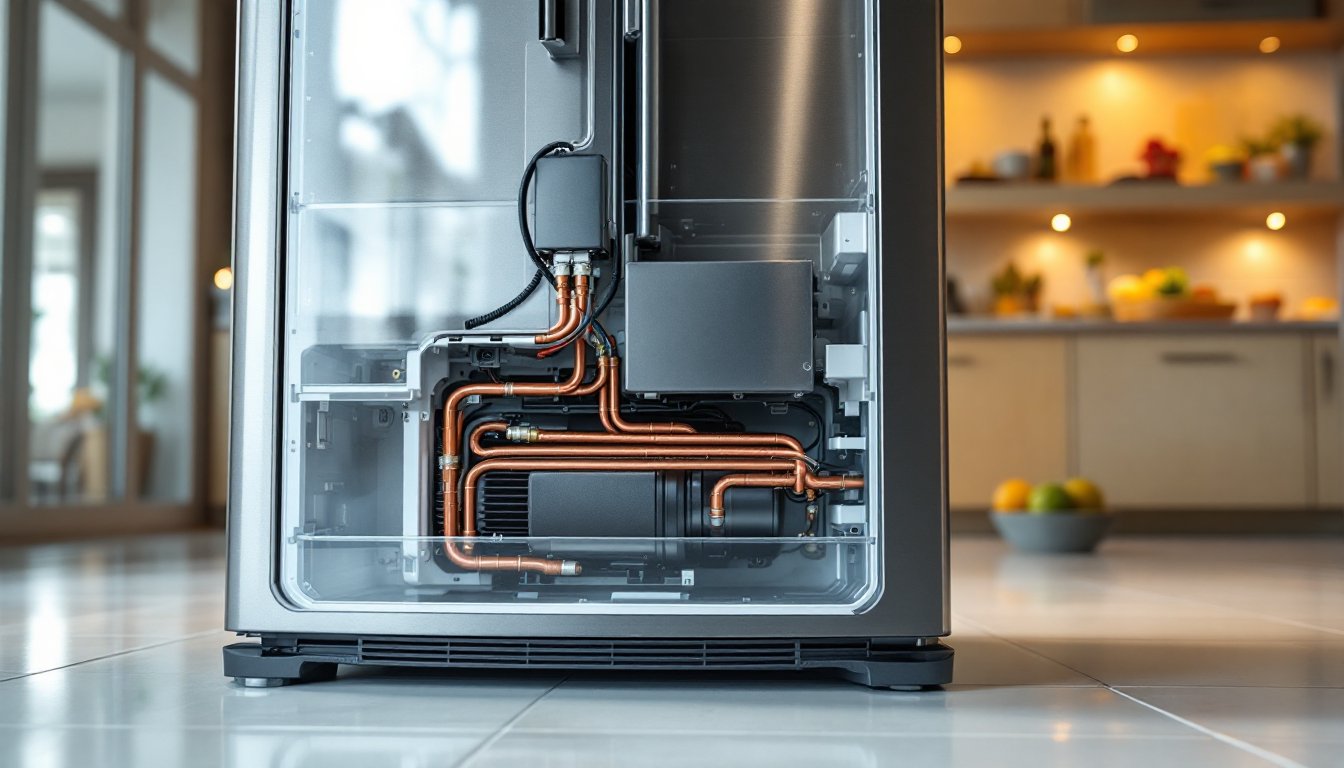
The compressor is essentially a motorized pump mounted at the base or rear of the refrigerator. It circulates refrigerant, a specialized coolant, through a closed-loop system of coils and tubes. The process begins when the compressor squeezes low-pressure refrigerant gas, converting it into a high-pressure, high-temperature gas. That hot gas flows through condenser coils (usually located on the back or bottom of the unit), where it releases heat into the surrounding air and condenses into liquid.
The liquid refrigerant then passes through an expansion valve, which drops its pressure and temperature sharply. This cold liquid enters the evaporator coils inside the fridge and freezer compartments, absorbing heat from stored food and air. As the refrigerant warms and evaporates back into gas, it returns to the compressor to repeat the cycle.
Most residential refrigerators use reciprocating compressors (piston-driven) or rotary compressors (scroll or rotary vane). Reciprocating units are common in older and budget models: rotary designs run quieter and more efficiently. Inverter compressors, a newer technology, vary their speed based on cooling demand, reducing energy consumption by up to 30% compared to fixed-speed models. They’re standard in many Energy Star–rated appliances.
The compressor runs intermittently, controlled by a thermostat or electronic control board. When interior temps rise above the setpoint (typically 37°F for the fridge, 0°F for the freezer), the control signals the compressor to kick on. Once temps stabilize, it cycles off. A healthy compressor should run for a few minutes, rest, then repeat, not continuously.
Key components that work alongside the compressor include the start relay (which provides the initial electrical jolt), the overload protector (which shuts the unit down if it overheats), and the capacitor (which stabilizes electrical current). Failure in any of these can mimic compressor failure, so accurate diagnosis matters.
Signs Your Refrigerator Compressor Is Failing
Compressor issues rarely happen overnight. Homeowners often notice subtle changes weeks before total failure.
Warm interior temps are the most obvious red flag. If food spoils faster or ice cream stays soft even though the thermostat setting, the compressor may not be generating enough pressure. Use an appliance thermometer to verify actual temps: settings on dials can be misleading, and proper temperature monitoring is essential for food safety.
Excessive noise is another common symptom. A healthy compressor hums or vibrates mildly when running. Loud clicking (start relay struggling), grinding (worn internal bearings), or banging (loose mounting bolts or internal parts) all suggest mechanical stress. If the compressor clicks repeatedly but never starts, the start relay or capacitor is likely shot, or the compressor motor itself is seized.
Continuous running without cycling off indicates the unit can’t reach target temps. This can stem from refrigerant leaks, clogged coils, or a compressor losing compression capacity. Check if condenser coils are caked with dust first: that’s an easy fix. If coils are clean and the unit still runs nonstop, the compressor is suspect.
Hot exterior surfaces around the compressor area are normal during operation, condenser coils dissipate heat. But if the compressor housing itself is too hot to touch for more than a second or two, the motor may be overheating due to internal friction or electrical issues. The overload protector will trip repeatedly, causing short run cycles.
Tripped breakers or blown fuses can also point to compressor failure. A failing motor draws excess current, especially during startup. If the fridge repeatedly trips a dedicated 15A or 20A circuit, the compressor or start components are likely drawing too much power.
Finally, visible refrigerant leaks, oily residue or frost buildup around tubing connections, mean the system has lost charge. Without adequate refrigerant, the compressor runs but can’t cool effectively. Refrigerant handling requires EPA Section 608 certification, so this is strictly a job for licensed HVAC or appliance techs.
Common Causes of Compressor Failure
Compressors are built to last 10–20 years, but several factors can shorten their lifespan.
Dirty condenser coils are the most preventable cause. Dust, pet hair, and grease accumulate on coils, blocking airflow and forcing the compressor to work harder. Over time, sustained high operating temps degrade internal components. Coils should be vacuumed or brushed every six months, more often in homes with pets.
Voltage fluctuations stress compressor motors. Power surges, brownouts, or running the fridge on an undersized circuit can damage windings or start components. In areas with unstable power, a surge protector rated for appliances (at least 1,500 joules) provides some insurance.
Refrigerant leaks starve the system of coolant, forcing the compressor to run continuously with little cooling effect. Leaks typically occur at brazed joints, service valves, or due to vibration damage. A hissing sound or oily residue near copper lines indicates a leak. Never attempt DIY refrigerant recharge, it’s illegal without certification and dangerous.
Worn internal components, pistons, valves, bearings, degrade with age. Reciprocating compressors are more prone to mechanical wear than rotary types. Once compression efficiency drops below about 70%, the compressor can’t maintain temps even with continuous operation.
Poor installation or maintenance accelerates failure. If the fridge isn’t level, oil may not circulate properly within the compressor. If door seals leak, the unit cycles too frequently, racking up runtime hours. Overstuffing the fridge blocks airflow, making the compressor work overtime.
Manufacturing defects do happen, though they’re less common. Some models have recalls or known compressor issues, check the manufacturer’s website and appliance repair resources for model-specific problems. Extended warranties sometimes cover compressor replacement within the first five years.
Should You Repair or Replace a Faulty Compressor?
This decision hinges on the appliance’s age, repair costs, and energy efficiency.
Repair makes sense if:
- The fridge is less than seven years old and otherwise in good shape.
- The issue is a failed start relay or capacitor ($50–$150 parts + labor), not the compressor itself.
- The unit is a high-end model with features (built-in ice maker, smart controls) that would cost significantly more to replace.
- An extended warranty or manufacturer’s recall covers the repair.
Replacement is usually smarter if:
- The fridge is 10+ years old. Even after a compressor swap, other components (evaporator fan, defrost system) may fail soon.
- The compressor itself needs replacement. Labor alone runs $300–$600, and OEM compressors cost $200–$500+, totaling $500–$1,100. A new mid-range fridge costs $800–$1,500, often with better efficiency.
- The unit uses R-12 or R-22 refrigerant (phased out under EPA regulations). Replacement refrigerants are expensive and may not perform as well.
- Energy costs are high. Older fridges draw 1,000–1,500 kWh/year: modern Energy Star models use 400–600 kWh/year. That’s $60–$130/year savings at average rates, paying for a new unit in 6–10 years.
Cost Considerations
Get quotes from at least two licensed appliance repair techs. Flat-rate diagnosis fees typically run $75–$150 and often apply toward repair costs. Ask if the quote includes refrigerant recharge, labor, and warranty on parts.
Factor in disposal costs for the old unit, $50–$100 if not included in new appliance delivery. Many retailers offer haul-away service.
For DIY-minded homeowners tackling kitchen upgrades, keep in mind that compressor replacement isn’t a realistic DIY project. It requires vacuum pumps, refrigerant gauges, torch brazing, and EPA certification. Even replacing a start relay, an easier task, involves working near high-voltage capacitors that can hold a lethal charge even when unplugged. If you’re not comfortable discharging capacitors with an insulated screwdriver, leave it to the pros.
DIY Troubleshooting Tips Before Calling a Professional
Before spending money on a service call, rule out simpler issues.
-
Check the thermostat setting. Someone may have bumped the dial. Verify it’s set to 37°F (fridge) and 0°F (freezer).
-
Clean the condenser coils. Unplug the fridge. Coils are usually behind a lower front grille or on the back panel. Use a coil brush or vacuum with a crevice tool. This alone can restore normal operation if the compressor was simply overheating.
-
Inspect door seals (gaskets). Close the door on a dollar bill. If it pulls out easily, cold air is escaping. Clean gaskets with warm soapy water: replace if cracked.
-
Level the fridge. Use a spirit level across the top. Adjust front leveling legs so the unit tilts very slightly back (about 1/4 inch over 24 inches). This helps doors self-close and ensures proper oil circulation in the compressor.
-
Listen for the compressor. Put your hand near the compressor (lower rear). If it’s silent and cool, the issue may be the start relay or control board. If it’s hot and clicking, the overload protector is tripping, likely a failing compressor or bad relay.
-
Test the start relay. Unplug the fridge, remove the relay (usually a small black box clipped to the compressor), and shake it. If you hear rattling, the internal contact is broken, replace it ($10–$30 part). If you’re comfortable with a multimeter, test for continuity between terminals per the wiring diagram (usually inside the door or online via the model number).
-
Check the circuit breaker. Ensure the fridge is on a dedicated circuit and the breaker hasn’t tripped. If it trips immediately upon reset, there’s an electrical short, stop and call a pro.
Safety note: Always unplug the fridge before any work. Wear safety glasses when handling coils (metal edges are sharp). Never discharge a capacitor without proper training: accidental contact can cause severe shock or burns.
How to Extend Your Compressor’s Lifespan
Routine maintenance adds years to a compressor’s service life.
Clean condenser coils every six months. Set a calendar reminder. This single task prevents most overheating-related failures.
Maintain proper clearances. Leave 1–2 inches of space between the fridge and walls for airflow. Don’t block the front grille or back panel.
Keep the interior organized. Overpacking restricts air circulation, forcing the compressor to run longer. Aim for about 75% full, enough mass to retain cold but not so much that vents are blocked.
Replace worn door seals promptly. Leaky gaskets make the compressor cycle more frequently. Replacement seals cost $50–$80 and install with a screwdriver and adhesive.
Avoid temperature extremes. Don’t place the fridge near ovens, dishwashers, or in unheated garages where ambient temps swing wildly. Compressors struggle in conditions below 50°F or above 100°F.
Use a surge protector. A whole-home surge suppressor (installed at the breaker panel by an electrician, around $300–$500) is ideal. Plug-in units work too but offer less protection.
Defrost manual-defrost units regularly. Frost buildup in freezers insulates the evaporator, forcing the compressor to work harder. Defrost when frost exceeds 1/4 inch.
Monitor run cycles. A healthy fridge should cycle on and off every 15–30 minutes under normal use. Continuous running or very short cycles (under five minutes) suggest developing issues, address them before the compressor fails.
Check manufacturer bulletins. Some models have known issues or free extended warranties. Register your appliance and check the manufacturer’s site annually for updates.
By treating the compressor as the critical component it is, not an invisible part that runs until it doesn’t, homeowners can stretch service life well into the second decade and catch small problems before they become expensive failures.