Living without a full-size dishwasher doesn’t mean resigning yourself to endless hand-washing. For apartment dwellers, tiny-home enthusiasts, RV owners, and anyone dealing with a kitchen that’s short on plumbing hookups, a countertop dishwasher with a water tank offers a genuinely practical solution. Unlike traditional countertop models that require a faucet connection, these portable units feature built-in reservoirs, you fill them manually, hit start, and let the machine handle the rest. They’ve come a long way since the clunky models of a decade ago: today’s versions are quieter, more energy-efficient, and capable of tackling a surprising amount of dirty dishes in a single cycle.
Table of Contents
ToggleKey Takeaways
- A countertop dishwasher with water tank eliminates the need for plumbing hookups, making it ideal for renters, RV owners, and anyone in spaces without standard faucet connections.
- These portable units use just 5–7 liters of water per cycle—less than half the water consumed by hand-washing—while maintaining high-temperature sanitation at 140–160°F.
- Countertop dishwashers with built-in tanks handle 4–6 place settings and complete wash cycles in 40–90 minutes, offering flexibility for small households, apartments, and supplemental dishwashing needs.
- Key buying considerations include tank capacity (5–8 liters), drainage options (direct hose, internal gray-water tank, or bucket drain), and features like adjustable racks, wash programs, and noise levels (45–60 dB).
- Setup requires no installation or modifications—simply fill the reservoir, load dishes, add detergent, and let the machine run, making it perfect for move-friendly living situations and vacation use.
What Is a Countertop Dishwasher with Water Tank?
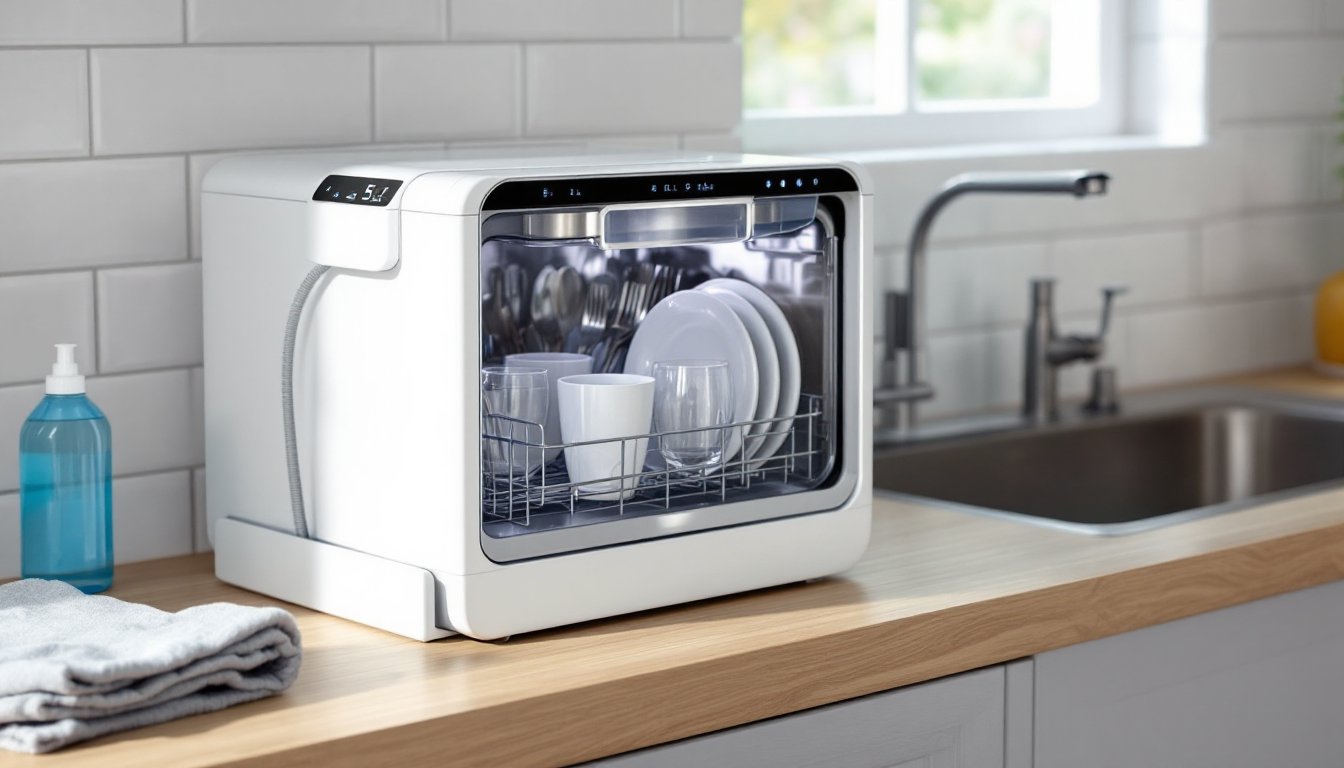
A countertop dishwasher with water tank is a compact, portable dishwasher designed to sit on your kitchen counter and operate without permanent plumbing connections. Instead of hooking up to a sink faucet or water supply line, it features an integrated reservoir that you fill manually before each wash cycle.
These units typically measure 16–20 inches wide and 17–20 inches tall, roughly the footprint of a large microwave. Most handle four to six place settings per load, which translates to dinner plates, bowls, glasses, and utensils for a small household or a couple of meals’ worth of dishes.
The key difference from standard countertop dishwashers? Complete installation flexibility. You don’t need a nearby faucet adapter or any plumbing modification. Pour water into the top-mounted tank, load your dishes, add detergent, and you’re set. Drainage usually works via a hose that empties into your sink or a bucket, though some models feature internal holding tanks for gray water that you empty manually after the cycle completes.
How Does a Water Tank Countertop Dishwasher Work?
The operational principle mirrors a full-size dishwasher, just scaled down with manual water sourcing. Here’s the cycle breakdown:
-
Manual filling: You pour clean water (typically 5–6 liters for a full wash cycle) into the built-in reservoir. Some models have fill-level indicators: others use transparent tanks so you can eyeball it.
-
Heating and spraying: Once started, an internal heating element warms the water to 140–160°F, which is hot enough to break down grease and sanitize dishes. A pump circulates the heated water through spray arms, similar to conventional dishwashers, targeting dishes from multiple angles.
-
Detergent dispensing: You add dishwasher detergent (powder, liquid, or tablets) to a designated compartment. The machine releases it at the appropriate cycle stage, usually during the main wash.
-
Rinsing and draining: After the wash phase, the unit drains dirty water through a hose routed to your sink or into a collection bucket. It then uses fresh water from the tank (or prompts you for a refill, depending on capacity) for a rinse cycle.
-
Drying: Most models use either condensation drying (residual heat evaporates moisture) or a small fan to dry dishes. Don’t expect the bone-dry results of a full-size unit with heated dry: you may need to crack the door open post-cycle for better air circulation.
The entire process typically takes 40–90 minutes, depending on the selected wash program (light, normal, heavy, or quick wash).
Key Benefits of Using a Countertop Dishwasher with Built-In Tank
No plumbing modifications required. You can set up one of these machines in under five minutes. That’s a game-changer for renters who can’t alter kitchen fixtures or anyone in a space where the sink isn’t compatible with standard faucet adapters.
True portability. Because there’s no hose tethering the unit to your faucet, you can move it between counters, take it to a vacation cabin, or even use it in an outdoor kitchen setup. RV and boat owners particularly appreciate this flexibility.
Water and energy efficiency. These dishwashers use roughly 5–7 liters of water per cycle, significantly less than the 10–15 gallons consumed by hand-washing the same load. Energy consumption averages around 0.5–0.7 kWh per cycle, comparable to running a laptop for several hours. Many units now carry Energy Star ratings, and modern models with smart appliance integration can even optimize cycles based on load sensors.
Space-saving design for small kitchens. If you’re working with limited square footage, think studio apartments, in-law units, or galley kitchens, a countertop unit beats a bulky portable dishwasher on wheels. When not in use, some models are compact enough to stow in a cabinet or pantry, though most users leave them out given their relatively small footprint.
Sanitation boost. High-temperature water cycles kill bacteria more effectively than typical hand-washing, which rarely exceeds 110°F. For households with young children, immune-compromised individuals, or anyone concerned about foodborne pathogens, that’s a meaningful advantage.
Who Should Consider a Portable Water Tank Dishwasher?
Renters in apartments without built-in dishwashers. Installing a full-size unit usually requires landlord approval and a plumber. A water-tank model sidesteps both, and you can take it with you when you move.
Tiny-home and van-life dwellers. Limited space and off-grid water systems make traditional dishwashers impractical. A portable unit with a tank integrates easily into compact, mobile living setups. Pair it with a gray-water collection system, and you’re good to go.
RV and boat owners. Onboard water supplies are finite, so efficiency matters. These dishwashers let you wash a full load with a known, controlled water volume, no guesswork or excessive consumption. Drainage into an onboard holding tank is straightforward with the right hose routing.
Office kitchenettes and break rooms. Small workplaces often lack the infrastructure for a full dishwasher but generate enough dirty mugs and lunch containers to make hand-washing a chore. A countertop unit keeps the sink clear and maintains hygiene standards without major renovation.
Seniors or individuals with limited mobility. Bending over a sink for extended hand-washing can be taxing. Loading a countertop dishwasher at a comfortable height reduces physical strain, and the machine handles the scrubbing.
Supplemental dishwashing in larger households. Some families use a countertop unit as overflow capacity, quick cycles for baby bottles, lunch containers, or dishes that pile up between main dishwasher runs. Insights from kitchen planning experts at The Kitchn highlight how secondary appliances can smooth daily routines in busy homes.
What to Look for When Buying a Countertop Dishwasher with Water Tank
Capacity and Size Considerations
Place-setting capacity ranges from four to six settings in most water-tank models. A four-setting unit handles two people comfortably: six settings can manage a small family or a day’s worth of dishes for a couple. Measure your available counter space before committing, most units need at least 18 inches of width and 18 inches of depth, plus clearance above for the door to open and for ventilation.
Check internal rack configuration. Adjustable or removable racks add versatility, letting you fit taller items like water bottles or small pots. Some models include a dedicated cutlery basket: others use a flatware tray on the top rack. If you regularly wash baby bottles or wine glasses, confirm the interior layout accommodates those shapes without crowding.
Actual dimensions matter: A unit advertised as “compact” might still be too bulky for a narrow galley counter. Compare the appliance’s footprint against your workspace, remembering you’ll need a few inches of clearance on at least one side for the drainage hose.
Water Tank Size and Drainage Options
Tank capacity typically falls between 5 and 8 liters. Larger tanks mean fewer mid-cycle refills, but they also add weight when full, an 8-liter tank weighs roughly 17.5 pounds when filled (water weighs about 2.2 lbs per liter). If you plan to move the unit frequently, a smaller tank may be more practical.
Look for transparent or graduated tanks with clear fill lines. Guessing at water levels leads to either insufficient washing or overflow issues. Some higher-end models include low-water alarms or auto-pause features if the reservoir runs dry mid-cycle.
Drainage setup varies:
- Direct drain hose: A flexible tube (usually 4–6 feet long) routes wastewater to your sink. You’ll need to position the unit within hose reach or use an extension.
- Internal gray-water tank: The machine holds used water in a separate compartment you empty manually post-cycle. Convenient if your sink is far away, but adds a step to the process.
- Gravity drain into a bucket: Works anywhere, though you’re responsible for dumping the bucket. Fine for occasional use: less appealing for daily cycles.
Ensure the drain hose has a secure clamp or clip to prevent it from slipping out of the sink during operation. Water spraying across your counter mid-cycle is a mess you don’t want. According to appliance reviews from Good Housekeeping, a snug hose fit is one of the top user complaints when overlooked.
Additional features to evaluate:
- Wash programs: At minimum, look for light, normal, and quick-wash cycles. Heavy-duty or sanitize modes are useful for greasy cookware or items needing extra sterilization.
- Noise level: Measured in decibels (dB), quieter models run at 45–50 dB (comparable to a quiet conversation), while louder units hit 55–60 dB (normal talking volume). If your kitchen opens to a living area, noise matters.
- Drying performance: Condensation drying is standard but leaves dishes slightly damp. Fan-assisted drying or a vent system improves results. User reviews on Homedit often highlight drying capability as a deciding factor.
- Cycle time: Quick-wash programs (20–30 minutes) are handy for lightly soiled items. Standard cycles run 60–90 minutes. If you need dishes clean fast, prioritize models with efficient short programs.
- Detergent compatibility: Most accept powder, liquid, or tablet detergent. Some recommend specific types for optimal performance: check the manual.
- Build quality and warranty: Stainless-steel interiors resist staining and odors better than plastic. A one-year warranty is typical: extended coverage suggests manufacturer confidence.
Safety note: These units get hot during operation. Keep them away from cabinet overhangs or anything that could melt or warp from residual heat. Ensure the electrical outlet can handle the appliance’s draw, most require a standard 120V, 15-amp circuit in the U.S. Don’t use an extension cord: plug directly into a grounded outlet to avoid fire risk.