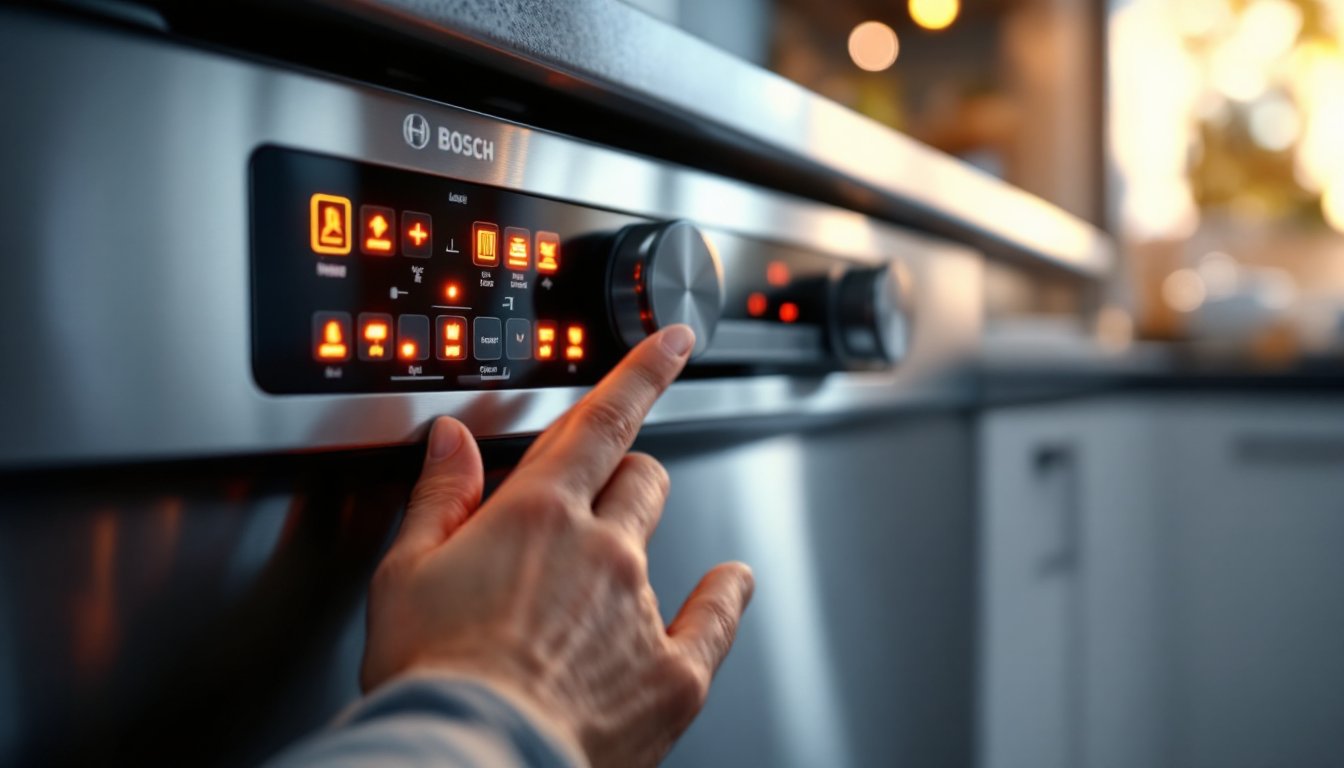
When every light on a Bosch dishwasher panel suddenly illuminates or starts blinking, it’s not a feature, it’s the machine’s way of signaling a problem. This all-lights-on condition typically halts the wash cycle and leaves homeowners staring at a control panel that looks more like a Christmas tree than a functional appliance. The good news? Most causes behind this issue are fixable without calling a technician. Understanding what triggers the error, how to troubleshoot it methodically, and when to attempt a reset can get that dishwasher back to cleaning dishes within the hour.
Table of Contents
ToggleKey Takeaways
- A Bosch dishwasher with all lights on indicates a general fault condition requiring diagnosis and reset, most commonly caused by door latch issues, water supply problems, or drainage blockages.
- The door latch assembly is the most frequent culprit behind the all-lights-on error; inspect and clean the latch hook, strike plate, and gasket before attempting complex repairs.
- Power cycle your Bosch dishwasher at the circuit breaker for five minutes to reset the control board and clear temporary fault codes before pursuing mechanical troubleshooting.
- Check for standing water in the tub, verify water supply pressure and inlet screen cleanliness, and ensure the drain hose forms a high loop to prevent siphoning issues.
- Call a professional technician if the door lock actuator fails to engage, water doesn’t flow despite clearing blockages, or the all-lights condition persists after reset and mechanical inspection.
What Does It Mean When All Lights Are On Your Bosch Dishwasher?
When all indicator lights illuminate or flash simultaneously on a Bosch dishwasher, the appliance is signaling a general fault condition. Unlike specific error codes that point to one component, this all-lights-on state is the dishwasher’s catch-all response when it detects multiple issues or can’t pinpoint a single fault.
Bosch dishwashers use an internal diagnostic system that monitors door locks, water flow, heating elements, and drainage systems. When the control board receives conflicting signals or can’t complete a self-check, it defaults to lighting up the entire panel. This stops the cycle to prevent water damage or component failure.
The flashing pattern varies by model. Some cycle through all LEDs in sequence, while others hold them steady. Both behaviors indicate the same thing: the machine needs attention before it’ll run another load. It’s worth noting that this differs from a single blinking light, which usually points to a specific component failure, understanding the difference between error patterns helps narrow down the fix.
This fault state often occurs mid-cycle but can also appear when starting a new wash. The dishwasher won’t accept new commands until the underlying issue is addressed and the system is reset.
Common Causes of All Lights Flashing on Bosch Dishwashers
Door Latch and Lock Problems
The door latch assembly is the most frequent culprit. Bosch dishwashers won’t start or continue a cycle unless the door is fully latched and the electronic lock engages. If the door strike plate is misaligned, the latch sensor misreads the door status, or the lock actuator malfunctions, the control board triggers the all-lights-on error.
Common door-related triggers include:
- Debris in the latch mechanism: Food particles, detergent buildup, or mineral deposits prevent the latch from seating completely. Inspect the strike plate on the door frame and the corresponding latch hook on the door itself.
- Worn door gasket: A compressed or torn gasket allows slight movement when the door closes, tricking the sensor into thinking the door isn’t secure.
- Failed door lock actuator: The motorized lock that secures the door can wear out, especially in units over five years old. A clicking sound when starting a cycle without the lock engaging is a telltale sign.
Open the door and manually check if the latch hook moves freely. Wipe down all contact points with a damp cloth. If the strike plate is loose, tighten the mounting screws, it should be flush against the tub frame.
Water Supply and Drainage Issues
Bosch dishwashers constantly monitor water inlet and drainage during operation. If water doesn’t enter at the expected rate or can’t drain properly, the control board halts the cycle and lights up the panel.
Water supply problems often stem from:
- A kinked or blocked inlet hose
- Low household water pressure (below 20 psi)
- A clogged inlet valve screen, this fine mesh filter sits inside the threaded connection where the water line attaches to the dishwasher
To check the inlet valve screen, shut off the water supply at the angle stop valve under the sink. Disconnect the inlet hose from the dishwasher using an adjustable wrench. Pull out the small screen filter with needle-nose pliers and rinse it under running water. Mineral buildup commonly restricts flow, especially in areas with hard water.
Drainage issues are equally common. The dishwasher’s drain pump must empty the tub between cycles. If water remains at the bottom of the tub after a cycle, check:
- The filter assembly at the tub floor, remove the lower spray arm by twisting counterclockwise, then lift out the cylindrical filter. Rinse thoroughly.
- The drain hose connection under the sink. It should rise to the underside of the countertop before descending to the disposal or drain line (high loop prevents backflow).
- The air gap if installed, this chrome dome on the sink or countertop can clog with food debris. Pop off the cap and flush with water.
Many diagnostic guides, including those from appliance troubleshooting resources, note that standing water triggers multiple sensor faults, leading to the all-lights condition.
Step-by-Step Troubleshooting to Fix All Lights On
Start with the simplest fixes before moving to component-level diagnostics. Most all-lights-on issues resolve within the first three steps.
1. Power cycle the dishwasher
Turn off the dishwasher at the circuit breaker, not just the control panel button. Wait five full minutes to allow the control board capacitors to discharge. Flip the breaker back on. This clears temporary faults and resets the diagnostic system.
2. Inspect and clean the door latch
Open the door fully. Examine the latch hook on the door edge and the strike plate on the tub frame. Wipe both with a cloth dampened with white vinegar to remove buildup. Check the door gasket for damage, replace it if cracked or flattened. Close the door firmly until it clicks. The latch should hold the door tight against the gasket.
3. Check for standing water
Open the door and inspect the tub bottom. If water remains, the dishwasher didn’t complete its drain cycle. Remove the lower spray arm and filter assembly. Bail out excess water with a cup or wet/dry shop vac. Clean the filter thoroughly, trapped food or broken glass blocks drainage.
4. Test the water supply
Under the sink, locate the angle stop valve feeding the dishwasher (usually a 3/8-inch compression valve). Ensure it’s fully open, the handle should be parallel to the supply line. Disconnect the inlet hose at the dishwasher end and hold it over a bucket. Open the valve. Water should flow at a steady rate. Weak flow indicates a supply line restriction or low pressure.
5. Verify drain hose configuration
Trace the drain hose from the dishwasher to the disposal or drain line. It must form a high loop (secured to the underside of the countertop with a bracket) to prevent siphoning. If the hose sags below the tub level, the dishwasher can’t drain properly. Some kitchens, especially those following modern kitchen design standards, integrate air gaps for code compliance, clean these if present.
6. Run a test cycle
After addressing any issues, start a rinse-only cycle. Listen for the door lock to engage (a distinct click within five seconds of starting). Watch for water to enter the tub. If the lights flash again immediately, the problem is electrical or sensor-related.
Safety note: Always wear rubber gloves when handling filters or components exposed to food debris. If working with electrical connections or testing the door lock mechanism, keep a dry work area and disconnect power at the breaker.
When to Reset Your Bosch Dishwasher and How to Do It Properly
A reset clears fault codes stored in the control board’s memory. It’s appropriate after fixing a mechanical issue or when the all-lights condition appears without an obvious cause. Don’t use a reset as a first step, it won’t fix a broken latch or clogged filter.
Standard reset procedure:
- Press and hold the Start button for 3-5 seconds until the active light turns off.
- If that doesn’t work, open the door and press the Start button again for 3 seconds.
- Close the door. The dishwasher should beep and reset to standby mode.
For older Bosch models without a digital display, the button sequence differs:
- Press and hold Rinse and Start simultaneously for 3 seconds.
- Release both buttons.
- Press Start once more.
Factory reset (use sparingly):
This erases custom settings and returns the dishwasher to out-of-box defaults. Only perform this if a standard reset doesn’t clear the lights.
- Turn off power at the circuit breaker.
- Wait 10 minutes (this fully drains residual power).
- Restore power.
- Open the door and press the On/Off button five times within 5 seconds.
- Close the door.
After any reset, run a short test cycle with no dishes to confirm the machine operates normally. If the all-lights condition returns immediately, the issue isn’t a stuck fault code, it’s an active problem that needs mechanical repair.
Some homeowners confuse a reset with a diagnostic mode. Bosch dishwashers do have a service test mode (accessed by holding specific button combinations), but entering it without knowing how to interpret the results can cause more confusion. Stick to standard resets for DIY troubleshooting.
When to Call a Professional for Bosch Dishwasher Repairs
Certain conditions require a technician with diagnostic tools and access to OEM parts. Don’t sink hours into a repair that’s beyond DIY scope.
Call a pro if:
- The door lock clicks but doesn’t engage: The lock actuator or control board needs replacement. Actuators cost $80-$150, and installation involves disassembling the door panel, a fiddly job requiring patience and the right Torx bits.
- Water doesn’t enter even after clearing the inlet screen: The inlet valve solenoid may have failed. Replacement valves run $60-$100, but the repair requires disconnecting electrical harness connectors and soldering or crimping wires on some models.
- The all-lights condition persists after reset and all mechanical checks pass: This points to a control board fault. Boards range from $200-$400 depending on the model, and replacement involves mapping 10+ wire connections.
- Error returns immediately with a burning smell or unusual sounds: Could indicate a failed motor, pump bearing, or heating element, all requiring partial disassembly of the tub assembly.
Also consider a service call if the dishwasher is under warranty. Bosch typically offers a one-year parts and labor warranty, with extended coverage on certain components like the stainless tub (varies by model). DIY repairs can void warranty coverage.
Cost considerations: Service calls average $150-$250 for diagnosis plus parts and labor. If the dishwasher is over ten years old and requires board or pump replacement, weigh repair cost against replacement. A new Bosch dishwasher starts around $800-$1,000 for entry-level models.
For newer units (under five years), repairs almost always make financial sense. For older machines, calculate whether spending $300+ on parts and service extends the life enough to justify it versus putting that money toward a new appliance with updated efficiency and features.